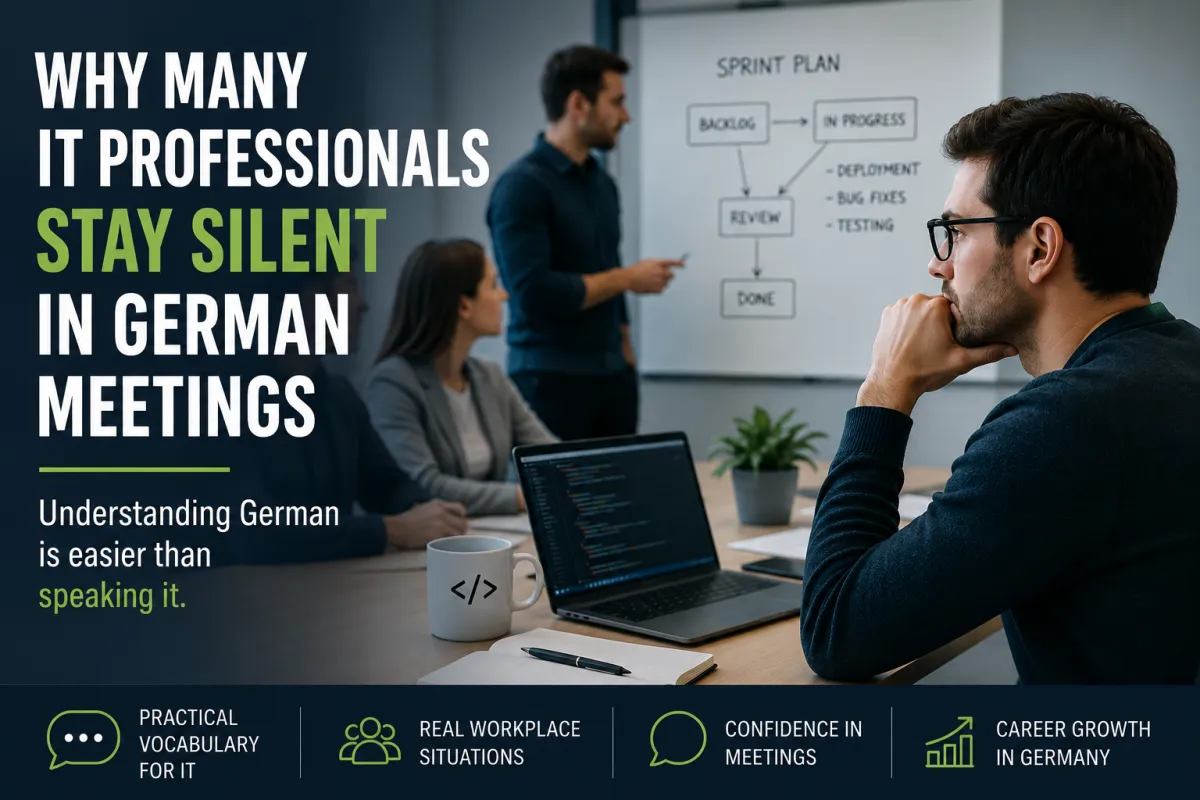
Why Many IT Professionals Stay Silent in German Meetings
Why Many IT Professionals Stay Silent in German Meetings
Many international IT professionals in Germany have the same experience:
They understand almost everything in meetings. They read messages, tickets, and documentation. They can follow conversations.
But when it’s time to speak, something changes. They slow down. Search for words. Switch to English. Or stay quiet completely.
And after a while, the team often switches to English for them.
Not because they are not skilled. Not because they are not intelligent.
But because understanding a language and actively using it in real-time are two very different things.
The Real Problem Is Not Grammar
Most professionals already know more German than they think.
The problem is usually not: vocabulary lists, grammar tables, textbook exercises.
The real problem is this: They have never practiced the situations that actually happen at work.
For example:
giving a quick update in a stand-up
reacting to feedback immediately
asking a question in a meeting
explaining a blocker clearly
disagreeing professionally
speaking while people are waiting for an answer
These are high-pressure communication situations — especially in IT environments where meetings move quickly and clarity matters.
Generic German Courses Often Feel Irrelevant
Many language courses still teach German through situations like: ordering food, talking about hobbies, describing vacation plans.
But developers, engineers, DevOps specialists, and project managers spend their days talking about:
systems
deadlines
deployments
tickets
priorities
incidents
stakeholders
Learning becomes much easier when the language is connected to the world you already know.
That’s why IT-focused German training can make such a big difference.
Speaking Needs Practice — Not Perfection
A lot of professionals wait until their German feels “good enough” before they start speaking more actively. Usually, the opposite is true.
Confidence comes after repeated use in realistic situations — not before.
You do not need perfect German to participate in meetings.
But you do need:
structure
ready-to-use phrases
realistic practice
and enough repetition to stop overthinking every sentence
German Is Still Important in IT
Many companies in Germany work internationally and use English internally.
But in real life, German still matters:
in meetings
with clients
in leadership communication
in informal conversations
in company culture
and for long-term career growth
For many international professionals, German is not just a language goal anymore.
It becomes the difference between:
observing and participating
understanding and contributing
being included and staying on the outside
Final Thought
Most IT professionals do not need “more German”.
They need German that actually fits the way they work.
Structured. Practical. Relevant. Built around real communication situations.
Because meetings are harder than grammar.